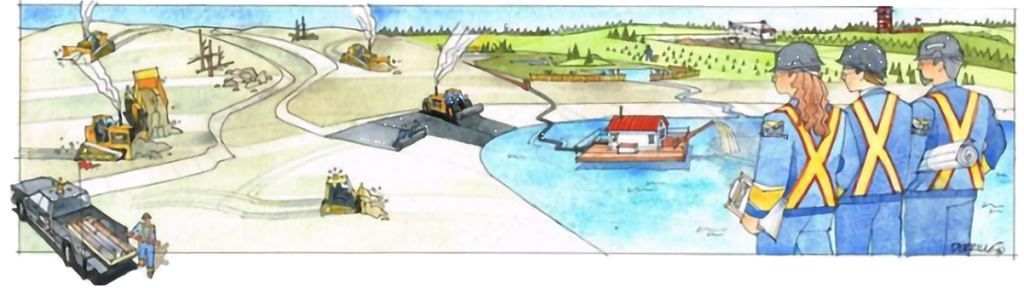
In a nutshell: Mine review boards provide independent, non-binding advice to help mining companies manage risks related to design, construction, operation, reclamation, and maintenance of their mining landforms and landscapes.
Around the world, mine review boards provide independent, non-binding advice to help mining companies manage risks related to design, construction, operation, reclamation, and maintenance of their mining landforms and landscapes.
ReviewBoards.org is an online resource that provides the mining industry, regulators, and local communities with information on establishing, operating, and sustaining independent review boards to manage risks and guide decision-making. It offers a recipe for developing and operating a successful review board, along with advice on drawing up the board’s charter, selecting members, preparing presentations made to the board, and sustaining a review board.
This website was launched in November 2025, and we look forward to getting your feedback and insights into how it can be improved.
History
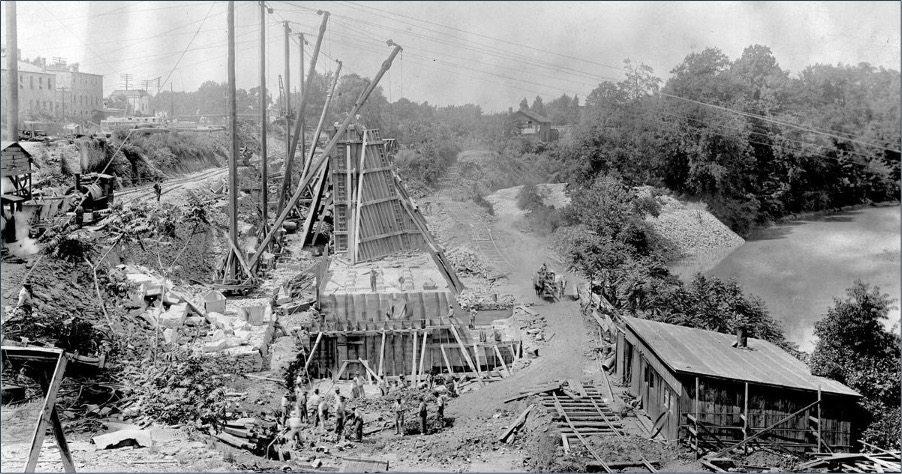
Review boards for large civil projects have been common for hundreds of years. A few historic non-mining examples demonstrate the importance of this function. In 1869, a Board of Consulting Engineers was formed to bolster public confidence in the construction of the Brooklyn Bridge in New York City. When it opened in 1883, it was the longest suspension bridge in the world and considered a considerable feat of engineering and design. Attempts to build the Panama Canal extending back hundreds of years were met with failure. But in 1905, the International Board of Consulting Engineers was established to confirm whether the US was better off constructing a locked or sea-level canal across Panama, and the canal was completed in 1914. A geotechnical review board continues to provide advice to the project today.
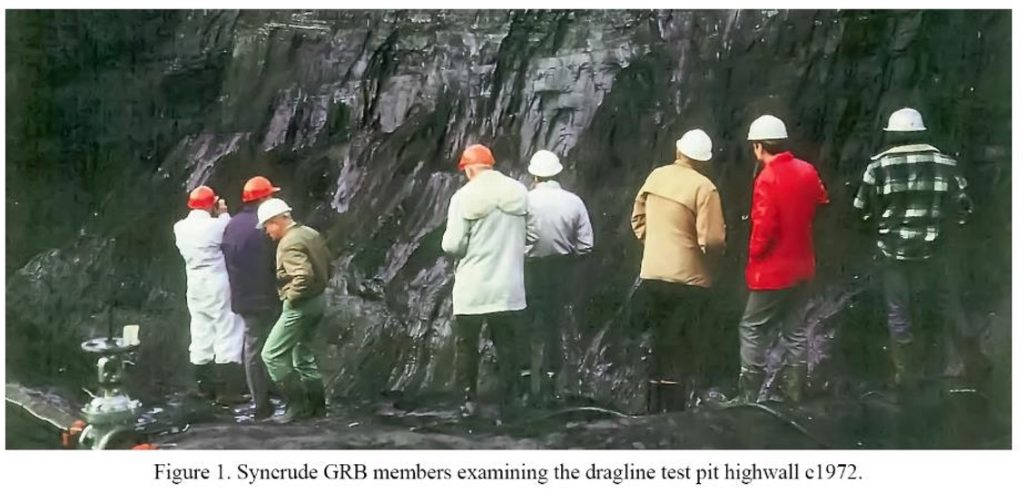
In the mining industry, review boards extend back about half a century. In Canada, one of the earliest was the Syncrude Geotechnical Review Board. It was set up in 1972 to advise the company on the viability of dragline mining. Since then, the board’s mandate has evolved to include tailings management, waste dumps, mine closure, geoenvironmental issues, and the risks associated with hydrogeology.
In 2014, the British Columbia government in Canada, together with local First Nations, established the Independent Expert Investigation and Review Panel. Effectively a forensic review board, it was put together in response to the failure of a tailings dam that year at the Mount Polley Mine in the interior of the province. The Panel recommended that the province require review boards for all tailings facilities in the province. The BC government turned that recommendation into a requirement in 2017.
In response to other tailings dam failures internationally, the Global International Standard for Tailings Management (GISTM) debuted in 2020. It requires and outlines the role of review boards for tailings storage facilities. This standard sparked a dramatic increase in the number of review boards globally, and a huge demand for qualified review board members.
The benefits of review boards for heavy civil and mining projects are now widely documented. Matich (1986) provides an overview of the design and operation of review boards. Hoek and Imrie (1995) and Hoek (2001) describe review board formation and operation for dams, bridges, water supply tunnels, and hydroelectric projects. McKenna (1998) documents a case history of a 25-year mining geotechnical review board. Gordon (2009) describes the use of review boards for large hydro projects. Morgenstern (2010) provides concise guidance on the value and operation of geotechnical review boards for mining. The ICMM Good Practice Guide (2021) and MAC (2021) provide guidance on setting up and operating review boards for tailings facilities. McKenna (2022) provides a detailed overview of the Syncrude Geotechnical Review Board’s 50-year tenure. Robotham (2024) provides the most recent advice about mine review boards and clear thinking on many of the important details. All these references — and many more — are available under Resources.
Today, mine geotechnical and tailings review boards are commonplace. Reclamation and closure review boards are just starting to become more common.
Types of boards
Most review boards today focus on the design, operation, construction, and performance of tailings facilities. Some address pitwall design and performance, others groundwater and/or surface water, and some closure and reclamation. Many boards have mandates that cover more than one of these areas. Some mines have multiple review boards. It is most common for an existing geotechnical or tailings review boards to add expertise in mine closure and reclamation as these landforms make the transition from the deposition phase to reclamation.
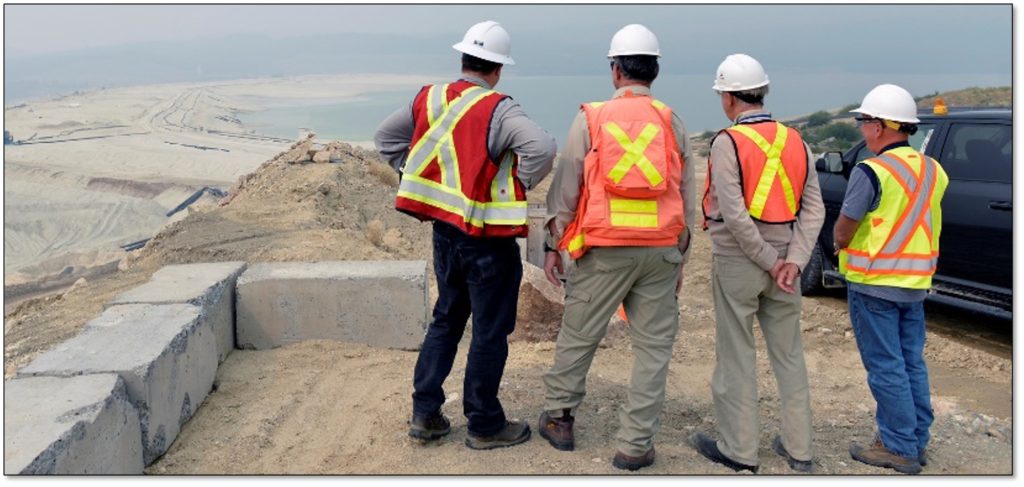
A board may also be assembled for a short-term specific task, such as choosing and implementing a mining or tailings technology, review a catastrophic failure (a forensic review board), or to help solve a specific operational problem. Such boards are typically known as advisory panels; their recommendations usually carry less weight than a review board.
Goals
Review boards provide independent, non-binding advice to help companies manage risks related to design, construction, operation, reclamation, and maintenance of their mining landforms and landscapes.
They also provide suggestions regarding cost savings and risk-reduction mechanisms. And they assess whether the mine has engaged qualified professionals, has sound designs, is building its facilities to design, and whether these facilities are performing as intended. This is the core mission of a mine review board.
The review board also provides coaching to senior professionals on design and construction, as well as emerging technologies and trends. The boards occasionally provide simple alternatives to what can become complex designs or processes. They also mentor young professionals who also benefit from observing professional board members interact with presenters, one another, and management.
Benefits
Mines hire review boards to help manage the risks associated with earthworks. Being able to rely on a review board helps shield senior management from liability in the event of poor performance or structural failure. For some mines, the impetus for starting a review board is to bring the mine into conformance with the GISTM or local regulations. Sometimes this is referred to a “tick box” review. It is then up to the board to prove its worth beyond meeting these minimum requirements.
Other duties of the board include coaching senior staff and consultants on design, construction, strategies, and emerging technologies; mentoring junior staff and consultants and coaching senior professionals and management; cross-pollination of innovative ideas, and technologies from other mines and industries. In many cases, communications from the board can bolster confidence among investors, regulators, and local communities.
A board earns its keep when it is:
- helping the mine move beyond precedents
- catching errors in design or construction
- helping mines avoid too-conservative and too-risky designs
- encouraging the use of new instrumentation and monitoring strategies and technologies
- supporting staff and management in decision-making
- sharing useful ideas from other mines.
The benefits of a review board do not only flow in one direction; members of boards have reported a variety of benefits of membership, including constantly learning from their clients and consultants; contributing to mining, society, and local communities; helping mines produce safely; social interactions with their colleagues during the meetings and at meals; and a chance to mentor the next generation of professionals. For many board members, such work comprises most or all of their professional practice and remuneration.
Costs
Mines track the cost of each review board meeting closely (mainly the board members’ fees, travel expenses, and the cost of catering), but this typically only represents a third of meeting costs. The lion’s share is in the analysis of data and preparation of presentations by mine staff and their consultants, and attendance in the meeting.
A small board meeting for 1 or 2 days typically costs $US75,000. A four-person board meeting for a week at the mine will run close to $US300,000. A large interdisciplinary panel meeting with numerous meeting participants can cost $US500,000.
Mines would not run such meetings if it were not important to the bottom line. Often review board members talk of looking at ways to help the mine save capital or operating costs — at least to offset the cost of the meeting, but also to be able to offer suggestions or recommendations that save the mine $10 million to $100 million every few years.
Mines track the cost of each review board meeting closely (mainly the board members’ fees, travel expenses, and the cost of catering), but this typically only represents a third of meeting costs. The lion’s share is in the analysis of data and preparation of presentations by mine staff and their consultants, and attendance in the meeting.
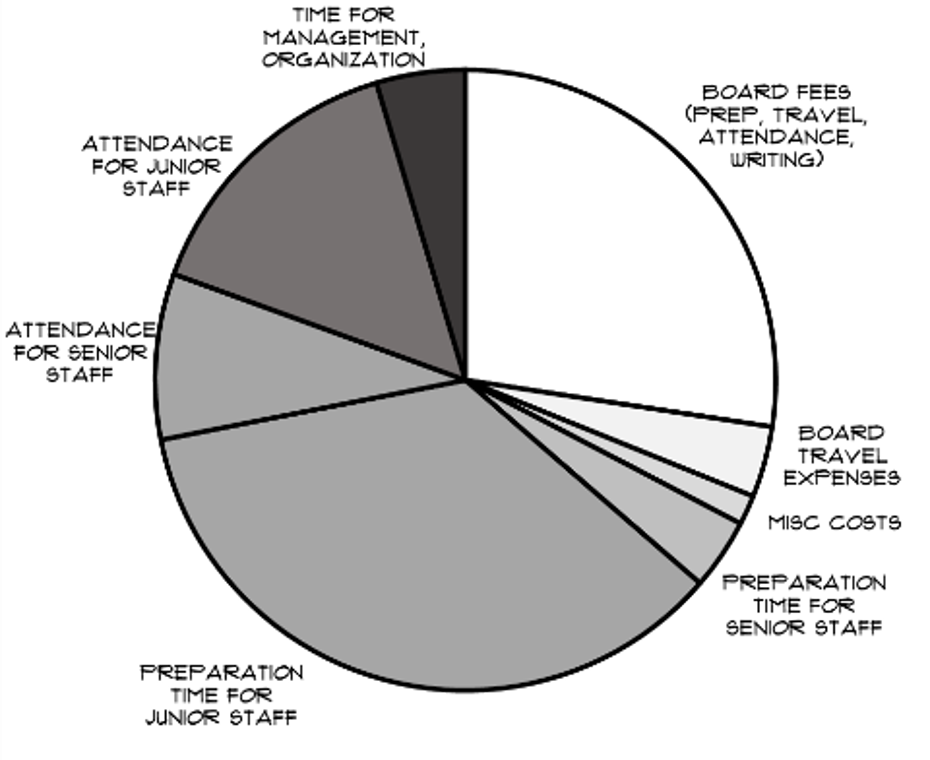
Mines would not run such meetings if it were not important to the bottom line. Often review board members talk of looking at ways to help the mine save capital or operating costs — at least to offset the cost of the meeting, but also to be able to offer suggestions or recommendations that save the mine $10 million to $100 million every few years.
A review board system
It can be useful to think of a review board as a system. Members acquire knowledge, skills, and experience throughout their careers. Knowledge of the state of practice and international standards are paramount. Practical field experience and an understanding of the legal, corporate, and regulatory frameworks are essential. The board passes that expertise on to the mine, the next generation of professionals, and to other and future review board members.
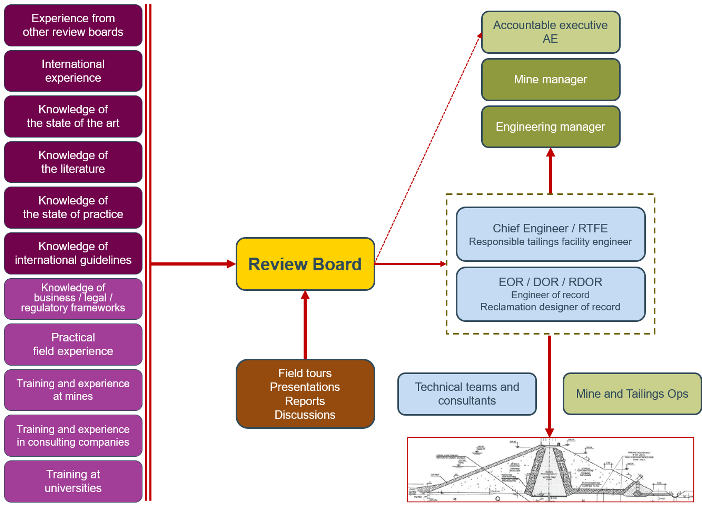
Once established, a review board gathers information from field tours and meeting presentations and provides verbal guidance during the meeting, more formally as part of the readout to management, and then in its final report. The board’s guidance is offered to the mine’s chief engineer, engineer of record, and the accountable executive who collectively implement the board’s recommendations, along with the mine’s technical, consulting, and operational teams. Over the years, the performance of the staff and structures is communicated back to the board, informs their advice to the mine, and deepens the experience of the board.
Trends
Both positive and negative trends can be found in the use and operation of review boards, all hot topics in any discussions about review boards.
On the positive side, there is increased interest in use of review boards (particularly in the wake of the GISTM), an expansion into geoenvironmental domains, reclamation, closure activities, and operating and closure water balances, increased involvement in closed mine sites, and steps to better absolve board members of liability for their work.
On the negative side, too much focus remains on tailings facilities — the liability for other mining landforms such as mine rock stockpiles, heap leaches, and surface water drainage systems is similar to and often greater than that posed by tailings facilities. Review boards are increasingly being drawn into governance and audit activities, their reports are becoming longer and wordier, board members report increasing frustration with the quality of cross-sections and maps provided for their review, and the contracting and commoditization of members by procurement staff is driving some members away. Many board members are reducing their workloads or retiring, creating an acute shortage of new qualified members. There is even a worry that some new review board members are “sub-qualified.”
A few other trends have been observed: many new board members have a more generalist background, and some have more local rather than international experience. The involvement of local communities in board activities presents a significant untapped opportunity, but also brings some risks.
Site credits
ReviewBoards.org is the creation of Gord McKenna, a geotechnical engineer based in Vancouver, Canada. Gord has more than 35 years of professional experience, including 17 years at the Syncrude oil sands mine in northern Alberta, Canada, and the rest as an international consultant to mines across Canada and around the world. He has been involved with review boards his entire career, sitting on both sides of the table, and has published several papers on the topic.
Since 2010, Gord has participated on 40 review and advisory boards and currently sits on 12 review boards. He also chairs the Landform Design Institute, which is mandated to make landform design common at mines worldwide. He is an adjunct professor at the University of Aberta. He possesses a BASc in Geological Engineering from the University of British Columbia and a PhD from the University of Alberta.
The offices of McKenna Geotechnical are situated near Vancouver, Canada on the unceded traditional territories of the xʷməθkʷəy̓əm (Musqueam), Sḵwx̱wú7mesh (Squamish), and səlilwətaɬ (Tsleil-Waututh) Nations. The term unceded acknowledges the dispossession of the land and the inherent rights that Musqueam, Squamish and Tsleil-Waututh hold to the territory.
The illustrations on this site are the creation of Derrill Shuttleworth.
Please contact Gord by phone or email with questions or comments on the website, and in particular ways that it can be improved, and references and resources that can be shared with others.
Gord McKenna, PhD, PEng, PGeol
Senior Geotechnical Engineer
McKenna Geotechnical Inc
5223 Laurel Drive
Delta, BC, Canada V4K 4S4
+1-604-838-6773
ReviewBoards.org
McKennaGeotechnical.com
landformdesign.com
gordmckenna.com